Showing posts with label culinary school. Show all posts

Tuesday, March 24, 2015

Culinary Homeschooling- Eggs, Cheese and Principles of Cooking

As I get further into my first culinary school textbook, I'm finding all sorts of interesting things I didn't know, and a fair share of things I did. For example, I did know this, so here is a clever little bit of trivia in case you didn't- the white part of the egg is actually called the albumen. 

The section on cheese was very very detailed. Step by step instructions for making homemade mozzarella was a big highlight for me, and something I really want to try. This chapter talked about how all cheese are made- by adding enzymes to mammal milk. The typical enzyme is rennet, which comes from the belly of calves- a fact I did not necessarily want to know.

Say CHEESE !!!
Did You Know?  Did you know that traditionally mozzarella cheese is made using buffalo milk? It's kind of funny that foodie types seem to think they are really eating a gourmet specialty if they find "boofalo mootzarell" when it should always be that way!

After filling my brain with cheese facts, I started the next big section- Part 3-Principles of Cooking. The fun is really starting now. I learned right off that, my previous thinking- that cooking is an art- is not really true. Actually cooking is not an art, as much as it is a science. I learned about the molecular changes in different foods when heat is applied, and about the different methods of heat transfer: conduction, convection, radiation and induction. The section also breaks down and explains all the methods of cooking we are all familiar with: broiling, roasting, steaming, boiling, and so on.

Chapter 10- Stocks and Sauces was a great chapter for me. Stocks and sauces are the bread and butter of the kitchen- master these and you can make almost anything. I am a longtime stockmaker and always have bags of bones in the freezer waiting for enough to roast and make a batch or two of rich, flavorful stock. This chapter walked me through the steps to making perfect stock, which I already knew, but it was still fun to see if I was missing anything. I'm NOT a perfect gravy-maker so I learned a lot from this chapter and hope I will become better at making gravies.


This chapter also introduces us to the mirepoix. The flavor foundation for all stocks, soups and sauces, the mirepoix is a must-have for all levels of cooking. This classic combination of onion, celery and carrots you will see used in soups, stews, casseroles, stocks and more.

Did you know? Did you know the proper name for vegetable stock is court bouillon? There are many kinds of veggie stocks out there but this is the mainstay, and is mostly used to poach or simmer other foods in.


Finishing out the chapter are the sauces- the History of Sauce, dating back to ancient Rome to today, and The Mother Sauces- Bechamel, Veloute, Espagnole, Tomato, and Hollandaise, and loads of variations with recipes. Lots of practice in saucemaking going on with this chapter. We start off learning all about making a roux (mastered that one long ago), as well as using cornstarch and other methods of thickening. 

Of all the chapters I have read so far, this was the most educational for me. Sure the earlier part of the book had history and some basic terminology I had not heard before, but seeing the techniques in actual recipes like all the sauce recipes was a huge bonus for me.

Up next in the book: soups. Perfect timing, as winter is winding down finally. After that we'll be cooking meat- time to dust off the grill!

Saturday, February 21, 2015

Culinary Homeschooling- Part Two

I thought this was going to be just oh so fun. Things took a dramatic turn for the worse today, as I began reading a most horrific set of chapters. Math. Restaurant math. Food costing. Breaking recipes and ingredients down into servings and cost-per-serving. Establishing menu prices based on math formulas taking into consideration cost per unit and servings per quantity. Now I need a drink!

Thankfully this is just for fun, and I won't be tested on any of these things. I'll be honest, math is NOT my friend. Three pages into how to calculate these things and I was really in over my head. If the raw food cost for one sandwich is $1.70 and the desired food cost percentage is 23%, the selling price must be at least $7.39. Huh?

          1.70 divided by .23 = 7.391

Ok, sure. Whatever you say (insert confused face). On to things that are much more entertaining. Like mise en place. Now I knew what that meant years before ever getting this book. Everything in it's place. In other words, get all your ingredients out, measured, and ready to use so once you start a recipe you don't have to stop and dig through the pantry for ingredients. No brainer, right? 

I read the chapter on knife skills. I love knives. Really. Kitchen knives are my obsession. The book set out the parts of a knife (I knew this), talked about different metals and why some are better than others (I knew this), why a full tang is better (I knew this) and broke down the differences in knife sharpeners and why people choose the different kinds for different uses. I now need to obtain a whetstone sharpener. And more knives.

The knife chapter also included a primer of knife skills and cuts. Rondelles. Chiffonade. Julienne, Batonnet. Brunoise. Dice. Paysanne. Tourner. I am going to get a couple carrots, some basil or small leafy green and a couple potatoes and spend a hour or two brushing up on my cuts and techniques.

I learned about calibrating a thermometer. Never thought I needed to do that, but I now have a new skill filed away in the brain for future reference. Oh coffee- an entire chapter devoted to coffee, all the different roasts, types of grinds, the how and whys. I never knew these things, so I did gain lots of new knowledge from this chapter especially. Did you know that in other countries American Roast is known as City Roast? Neither did I! 


I often play with French recipes and many times they call for creme fraiche. Living in a rural area means I often cannot find ingredients like this. Lo and behold....... this textbook reveals how to make it myself. This changes everything. I'll be a creme fraiche-making fool!

One notable section of the book covered butter and margarine. Everyone who knows me knows my utter disdain for margarine. I am not alone. This point is driven home in great detail in culinary school, and this textbook details the chemical composition of margarine, the history, the nasty stuff, the gross stuff, the hydrogenation process...... things that make the case for Just Say No To Margarine. I feel validated.

I am approaching the food chapters, so I hope you will continue to follow along. Now that I'm getting into the real food nitty gritty I can have some fun with demonstration and really testing my skills.

Saturday, January 31, 2015

Culinary Homeschooling, Part One

Ok, I am just being silly here. Thanks to the wonderland known as Ebay I have in my possession my first culinary school textbook. Yep, and it is nothing like I expected. I imagined recipes for amazingly difficult foods and detailed instructions on super fancy plating techniques. Nope. Nothing like that.

 
This book is the real deal. Food history. Sanitation and food safety. Culinary mathematics (yuck). Food costs. Nutrition. Menu planning. Many many chapters on the different categories of food. 1080 pages of....... textbook. What have I done? In all seriousness, my plan is to read this book, cover to cover, and see what I missed out on never having gone to culinary school. 


Obviously, my Culinary Homeschool experience is going to start with Chapter 1- Professionalism. In other words, the history, tradition and expectations of culinary professionals. What did I learn so far?
  • The brigade- a system of staffing a kitchen so that each worker is assigned a set of specific tasks; often related by cooking method, equipment, or the type of food being prepared.
  • The difference between a gourmet and a gourmand.
  • The three compartment sink.
  • All about macronutrients and micronutrients.
  • The differences between a static menu, a cycle menu, a market menu and a hybrid menu.

Just a couple chapters in I am actually a little bit intimidated by this immense book. Thirty five chapters cover every culinary subject imaginable to me. I have no plans to pursue a professional cooking career but I figure it can't hurt to spend some quality time with this book and I know I will learn a lot. At least I know there won't be any TESTS!

Oh, and before I forget- I titled this "Part One" in the hopes that you will continue to follow me on my Culinary Homeschool Project. What do you think I will discover in Part Two?

Monday, August 18, 2014

In the Kitchen with Deb- Guest Chef Adventures in Vegas

You might remember our friend Deb Tedesco-Roberts from her culinary school interview she did with us a while back. Well.... Deb has been busy this summer! Traveling, enjoying the Vegas nightlife, gardening and COOKING up a storm, Deb has invited us into her kitchen to see what happens when you send men off to fish for trout, and they deliver the goods.

This girl belongs on Food Network!
Going fishing is a rite of passage for many men, and while the "Manly Fishing Trip" may not be as common as it once was, occasionally you do hear of a group of guys making the escape from the city to a secluded cabin or campsite and spending some time at one with nature, baiting hooks and hoping to snag something worth bragging about. Deb's guys loaded up the equipment and headed off to Panguich Lake in Utah for some trout fishing, and judging by the pictures, they have the perfect fishing spot.


Manly men doing manly stuff at the lake


Deb's hubby Kurt seems to have won the fish lottery

Oh yaaaaaa.
While I love fishing, I was more excited to see what sort of kitchen magic Deb would be working when she got a hold of those beautiful, freshly-caught fish, and I was not disappointed. Fresh herbs, lemon, olive oil, wine, all lined up on the counter top, ready to lend their flavors, and an unbelievable amount of beautiful, flawless trout sit waiting for their ultimate destination- the dinner plate.

Trout is one of my very favorite fish. It's so delicious and easy to prepare, and if you leave it whole and don't feel guilty with him looking at you while you're eating him, make a striking presentation. Deb was working with trout but you can use whatever fish you prefer.

Look at these perfect trout! Lemon and herbs are
waiting in the background for their turn
First things first- head on or head off? That's up to you really. I personally don't like my dinner looking at me while I'm eating, so I'm a heads-off gal and so was Deb. Second thing you have to deal with is the skin. Cooking a whole fish is so much easier and gives a moister finished dish when you leave the skin on, so make sure to thoroughly remove all scales from your fish if it's a scaled fish. Not all fish are!

Extra virgin olive oil and Sauvignon Blanc-
match made in heaven with fish
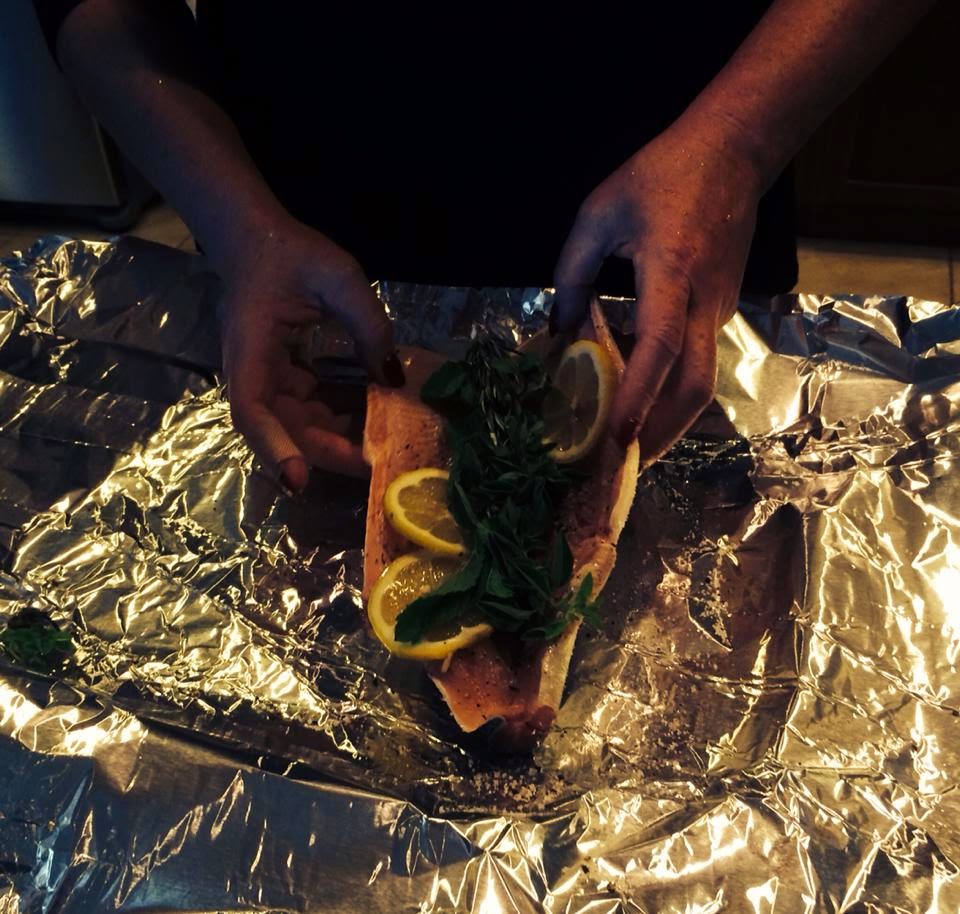
Seasoning your fish is a very important step. Of course you want salt and pepper, but you can add subtle flavors to fish by stuffing the cavity with thinly sliced lemon or other citrus, and lots of fresh herbs. Thyme, dill, Italian flat leaf parsley, fennel fronds all work well with fish.

Fish are stuffed with herbs and lemon
Adding a splash of a light wine, such as Sauvignon Blanc, and a drizzle of extra virgin olive oil accent the fish perfectly while adding moisture.

Get all that good stuff in there!

Don't neglect the exterior of your fish either. A nice rub of olive oil and season with salt and pepper before you wrap up your foil packets will ensure a tasty fish skin, especially if you finish with a quick broil to crisp up the skin.

Wrapping up bundles of deliciousness
Wrap up the stuffed and drizzled fish in foil and seal tightly! Place on a baking sheet and pop into a preheated 350 degree oven and don't peek for 30 minutes or so (depending on the size of your fish). When ready to test, you can tell the fish is cooked when a fork inserted shows flaky meat. You can check with a thermometer as well- it should be 140 degrees.

Cooking show- right??
While your fish is cooking, get your sides in order- a mushroom rice pilaf is delicious with fresh fish, or a crispy fresh tossed green salad with a light vinaigrette- perfect!


Don't they look fantastic? 


Deb's delicious fish was served with garden-grown tomatoes
and rice drizzled with pan juices from the fish- simple and perfect
Freshly caught trout makes a beautiful dinner and is just as easy to prepare at the campsite- simply cook your foil packets over the campfire or on a grill.You can have lots of fun with this dish too- invite friends over for a stuff-your-own fish feast and get your guests in on the fun in the kitchen, open a bottle or two of wine and enjoy!